
Table of Contents
In short
Grammarly for IELTS writing corrects grammar, punctuation and clarity. QuillBot rewrites phrasing and widens vocabulary.
Neither reads the exam prompt, so neither judges Task Response or Coherence and Cohesion — half your band score.
A 2026 Atlantis Press study recorded a +3.8 gain on Grammarly’s own grammar score but only +0.1 in human-graded bands.
Use both as a final surface sweep, after a tutor or band-aware checker has diagnosed the essay.
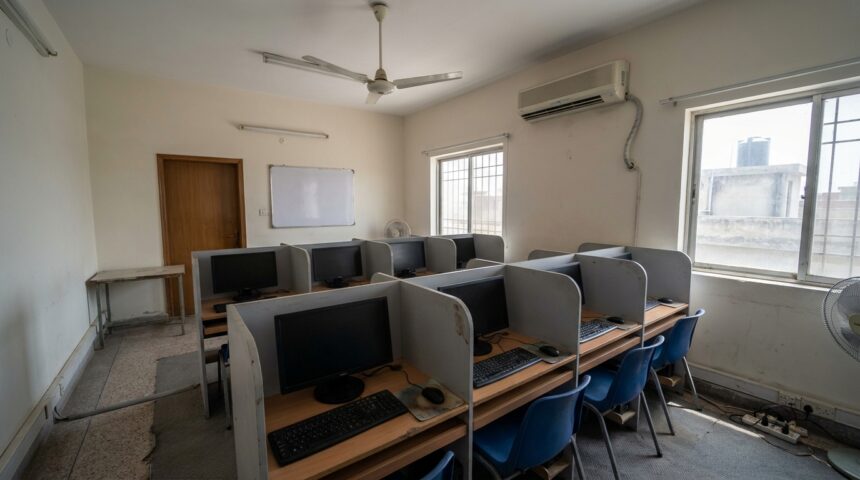
A candidate in Lahore pays about $12 a month on a dollar card, runs four practice essays through two AI editors, and walks into a test centre where the writing screen has no spellcheck at all. Grammarly and QuillBot improve accuracy and phrasing, but they do not assess whether you answered the question. That gap is the whole story: these tools reach two of the four official marking criteria and are blind to the other two, and the two they miss are the ones that decide whether you land Band 6.5 or Band 7.
What the two tools actually read
Grammarly scans your text for grammar, spelling, punctuation and clarity. QuillBot rewrites sentences for register and variety. Both work only on the words in front of them, with no access to the exam question and no knowledge of the band descriptors an examiner applies.
IELTS Writing is marked on four criteria, each carrying 25% of the score: Task Response, Coherence and Cohesion, Lexical Resource, and Grammatical Range and Accuracy. Two of those are about language. Two are about thinking — did you answer the prompt, and did you order your argument so a reader can follow it.
Grammarly’s engine flags verb tense slips, missing or wrong articles, preposition errors, comma faults and wordiness, then scores the text for clarity. It’s pattern matching over your sentences, which is exactly why it functions without ever seeing the question you were asked.
QuillBot works differently. Its Formal, Fluent and Academic modes restate your sentence with different vocabulary and syntax, so it lifts Lexical Resource and sentence variety — the skill IELTS Writing Task 2 rewards most directly. A January 2026 study in the Arab World English Journal by Alghamdi and Madini found EFL learners using QuillBot outperformed control groups on lexicon and coherence. Research on MA TESOL students records the other half of that picture: the same students reported dependency as a real risk.
Because neither tool ingests the prompt, Task Response and the logical ordering an examiner traces sit outside their reach. IELTSbiz makes the division plain: grammar tools serve Grammatical Range and Accuracy, and only checkers trained on the descriptors attempt Task Response.
| Tool | What it changes | Criterion it helps | What it cannot judge | Free tier |
|---|---|---|---|---|
| Grammarly | Grammar, punctuation, clarity, tone | Grammatical Range and Accuracy | Task Response, Coherence and Cohesion | Yes |
| QuillBot | Paraphrasing, register, sentence variety | Lexical Resource | Task Response, Coherence and Cohesion | Yes |
| IELTS-specific checkers (IELTSbiz, SmallTalk2Me, NIRVE AI) | Band estimate against published descriptors | All four, including Task Response | Fine proofreading | Varies by vendor |
DemandSage’s November 2026 comparison reaches a practical conclusion for students: Grammarly is stronger on original drafting and plagiarism checking, QuillBot leads on paraphrasing and summarising, and running both free plans together covers most of what a candidate needs.
What the trials actually measured
Take one body sentence from a Task 2 essay. The student writes: “In many developing country, the government is not spending enough money on the public transport, and this is affect the traffic.” Grammarly corrects it to: “In many developing countries, governments do not spend enough on public transport, and this affects traffic.” QuillBot’s Academic mode goes further: “In numerous developing economies, insufficient public investment in transport infrastructure has contributed to worsening congestion.”
Cleaner tense, tighter punctuation, less repetition. Real gains on two criteria.
Now the cost. If that paragraph argues the wrong point, or buries the argument three sentences in, the examiner still marks Task Response at Band 6.0. The surface is spotless and the score doesn’t move. That’s the clean-draft trap, and it is measurable.
The 2026 Atlantis Press study of ICT students confirmed Grammarly sharpens surface accuracy. It also showed how little that buys at the examiner’s desk. A randomised controlled trial of 466 EFL postgraduates published in the Saudi Journal of Language Studies in August 2025 found the same split from the other direction: syntactic complexity and precision improved substantially, while higher-order argumentation did not improve without human oversight.
There’s a second problem with trusting automated scores. An April 2026 analysis by EssayGradeWise found automated checkers diverge from human raters and return different scores when the identical text is resubmitted. If you’re deciding whether to pay the test fee this month or next, a number that drifts on resubmission is not a number to book against.
Why it matters once you are in the exam room
The computer-delivered IELTS writing interface gives you cut, copy, paste and a word counter. No spellcheck, no grammar suggestions, no autocorrect. On the paper test you get a pen. Every correction you leaned on during practice is simply absent, so the error you never learned to see turns up in the script the examiner marks.
Silent autocorrection removes the feedback loop entirely. Accept 200 suggestions without reading one of them and you’ve carried 200 uncorrected habits into the exam, as LetsWords argues in its comparison of grammar checkers and vocabulary trainers.
Then there’s the bill. As of November 2026, both products charge in US dollars on monthly or annual plans, so paying from Pakistan needs an international card or a dollar-enabled account. Student discounts advertised in other markets frequently fail to appear at checkout here. Check the live figure on the vendor’s own billing page before you commit — blog-quoted prices go stale fast, and currency conversion moves them again.
For most candidates preparing in Pakistan, the free tiers do the job. Grammarly’s free plan catches the error types that cost South Asian writers marks most often, and QuillBot’s free paraphraser handles practice drills. Paying is a choice about convenience, not about band outcomes.
Four things students get wrong about these tools
“A clean Grammarly score means a high band.” It does not. The 100-point clarity score tracks surface accuracy, and the Atlantis Press data shows that gain barely shifts the examiner’s judgement.
“Grammarly can tell me my band.” It cannot. Dr Niki Majidi of NIR Academy wrote in July 2026 that setting an IELTS-specific checker against Grammarly is “not a contest… they serve fundamentally different purposes.” One reads band descriptors. The other reads sentences.
“QuillBot writes better English than I do, so I should write in it.” Paraphrasing a machine’s sentence builds nothing you can retrieve in a timed, unaided exam. Study the rewrite; don’t produce the draft with it.
“More corrections equal more learning.” Explanation beats autocorrection. Switch on the reasoning behind each suggestion and log the repeat offenders — articles and prepositions dominate for most South Asian candidates.
Accepting suggestions without reading the explanation means the same article or preposition error returns in the exam, where no checker exists. Read the reason, note the error type in a log, and recheck your next essay for that one pattern.
A workflow that uses each tool where it works
Diagnose the band before you polish the surface, because polishing cannot fix Task Response. Run a surface sweep over a mis-targeted essay and you get a tidy Band 6.0 — which is why diagnosis has to come first. IDP IELTS makes the same case for keeping a tutor in the loop on task achievement and argument quality.
Five steps, about 90 minutes per essay
- Write the full Task 2 answer unaided in 40 minutes, no spellcheck, in the format you’ll sit — screen or paper.
- Get a band diagnosis from a tutor or a descriptor-trained checker, focused on Task Response and Coherence and Cohesion first (15 minutes).
- Fix structure and argument yourself, before any tool touches the text (20 minutes).
- Run Grammarly as a final surface sweep, reading the explanation behind every suggestion instead of accepting in bulk (10 minutes).
- Take your three weakest sentences into QuillBot for paraphrasing practice, compare the modes, then rewrite them in your own words from memory (5 minutes).
Keep an error log — one line per essay recording the criterion, the error type and the fix. Patterns only surface across four or five essays, and the log is what turns a correction into a habit.
The bottom line
Grammarly for IELTS writing is a proofreader. QuillBot is a rewriter. The examiner is scoring something neither of them reads. Both free tiers earn their place in a study plan; neither earns your trust on a band prediction.
Diagnose with a human or a band-aware checker, polish with the tools, keep the log.
FAQ
Is using QuillBot for IELTS preparation considered cheating?
No — practising with QuillBot breaks no IELTS rule, because no tool of any kind is permitted in the exam itself. The risk is pedagogical rather than disciplinary. Rehearse by rewriting machine output and you arrive at a timed, unaided task without the sentences in your own memory. Study the rewrite, then reproduce it yourself.
Are IELTS-specific AI checkers better than Grammarly?
For band feedback, yes — tools trained on the published descriptors, among them IELTSbiz, SmallTalk2Me and NIRVE AI, assess Task Response and Coherence and Cohesion, which Grammarly never attempts. They are weaker proofreaders. Use the band-aware checker for diagnosis and Grammarly for the final sweep, and verify any band estimate with a tutor before booking a test date.
Does paraphrasing software trigger plagiarism or AI-detection flags?
In IELTS, no — your script is handwritten or typed in a locked interface, so no detector runs on it. The exposure sits elsewhere. University assignments and visa documentation are routinely screened, and heavily paraphrased text draws flags. Keep QuillBot inside your practice drills, not inside work you submit for credit.
References
- Atlantis Press, 2026 — Grammarly use among ICT students
- NIR Academy, July 2026 — NIRVE AI vs Grammarly for IELTS writing
- EssayGradeWise, April 2026 — How accurate are AI IELTS writing checkers?
- IELTSbiz — Best grammar tools for IELTS writing
- IDP IELTS — AI vs tutor for IELTS reading and writing
- DemandSage, November 2026 — Grammarly vs QuillBot
- SmallTalk2Me — Best AI IELTS writing checkers in 2026
- LetsWords — Grammar checker vs vocabulary trainer