
Table of Contents
- Introduction: 12-Hour Outages Meet 99.99% Uptime
- What Data Center Backup Power Means at Tier III
- The K-Electric Baseline Operators Design Against
- Captive Power: Leaving the Grid Entirely
- Dual Feeds and Government-Backed Redundancy
- Battery and Generator Architecture for 12-Hour Outage Windows
- Diesel, Gas and Fuel Logistics
- Microgrids, Solar Hybrids and Peak Shaving
- The Next Bottleneck Is Water, Not Watts
- Why AI Racks Break Old Karachi Power Assumptions
- Capacity, Policy and What 53 MW by 2030 Requires
- What to Verify Before Signing a Karachi Colocation SLA
- Frequently Asked Questions
- Limitations and What This Analysis Does Not Cover
- Conclusion
- References
- Related Reading
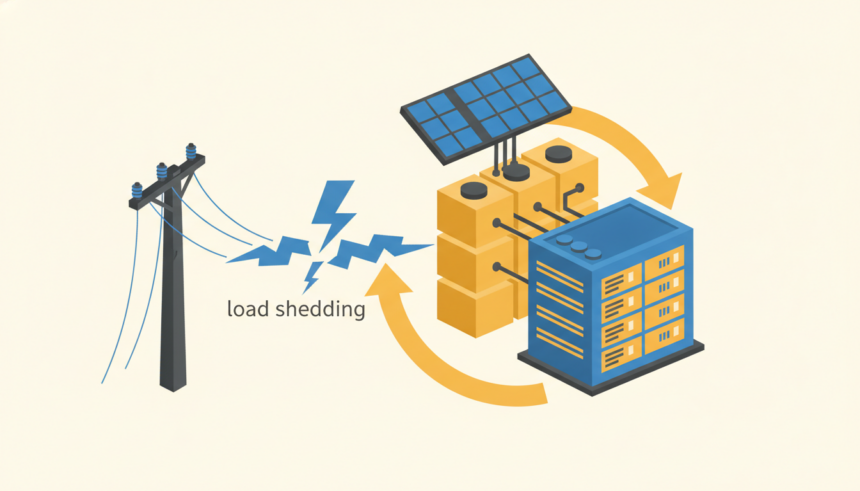
Data center backup power in Karachi is not a UPS question — it is a generation question. Operators that stay online in 2026 do four things: they site inside a load-shed-exempt industrial feeder zone; they contract captive generation with 30–70% headroom above design load; they hold dual grid feeds with automatic transfer between them; and they size lithium iron phosphate autonomy for the recharge window rather than the ride-through alone. The binding constraint on the next generation of Karachi facilities is not megawatts. It is cooling water, because an operator can build a private power plant but cannot build a private aquifer.
Introduction: 12-Hour Outages Meet 99.99% Uptime
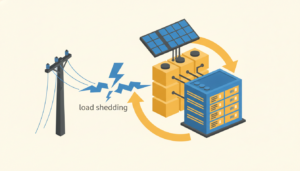
In October 2026, K-Electric extended load shedding to more than 150 feeders that had previously been exempt, pushing interruptions on affected circuits to 12–15 hours. Two months earlier, in August 2026, protests broke out across the city after unannounced outages reached 12 to 24 hours in some neighbourhoods. A Tier III facility, by contrast, is contractually allowed roughly 1.6 hours of downtime per year.
That gap is closed by inverting the conventional hierarchy. In Karachi, serious operators treat data center backup power as the primary supply and the utility as the standby source, because a feed that disappears for half a day cannot be the foundation of a 99.982% availability commitment. The design question is therefore generation capacity, fuel chain and stored energy — not switchgear branding.
The pressure is increasing rather than easing. Industry forecasts cited in Pakistani trade coverage put installed data center IT load at 23.5 MW in 2025, rising to more than 53 MW by 2030. Consequently demand is growing into the weakest part of the national electricity system rather than away from it, and it is concentrating in the one city where the grid made international news twice in a single quarter.
This article covers the engineering that follows from that constraint: redundancy topologies and what each one actually buys, K-Electric’s feeder politics, captive generation economics, battery chemistry under repeated deep discharge, diesel and gas logistics, the emerging cooling-water bottleneck, the load-shape change caused by AI racks, and the due diligence a buyer should complete before signing. It is written for infrastructure engineers, colocation buyers and research-computing leads evaluating onshore Pakistani capacity.
About this analysis. Written by The Verge PK’s infrastructure desk, which covers Pakistani telecom, data centre and energy engineering in local terms — tariffs, feeders, fuel availability and what the regulations here permit. Our editorial focus is the engineering and governance of compute infrastructure, including AI governance and data standards for multi-institution research teams.
5 Critical AI Governance Challenges in Multi-Institution Research Labs – theverge.pk
Transparency note. All project figures, outage durations, consumption volumes and policy references come from named 2025–2026 reporting, K-Electric statements and published standards, each linked in the References section. Battery performance figures are indicative industry ranges, not vendor-verified test data, and should be confirmed against manufacturer datasheets for a specific site. This article is analysis and general technical explanation, not a substitute for a site-specific electrical engineering study.
What Data Center Backup Power Means at Tier III
Data center backup power is the full chain from the utility feed through transfer switching, uninterruptible power supply and stored energy to on-site generation, sized so any single element can fail or be isolated for maintenance without dropping the IT load. Redundancy is a property of the whole chain, not of one cabinet.
The uninterruptible power supply in a data center deserves an honest description, because local marketing material routinely overstates it. A UPS bridges seconds to minutes. Its purpose is to carry the critical load across the transfer to generation, not to replace generation. Therefore in a market where outages run 12 to 15 hours, the UPS is the least interesting component in the chain and the generation contract behind it is the most interesting. A buyer who spends an hour on UPS topology and five minutes on fuel storage has inspected the wrong half of the system.
Concurrent maintainability is the clause that defines Tier III under the Uptime Institute’s Tier Standard: every capacity component and every distribution path must be removable from service, deliberately, while the computing load continues to run. This is precisely the language operators invoke when negotiating a second feeder with K-Electric, because a single utility path cannot be concurrently maintained by definition. One feed means one path, which means the facility fails the standard at the point of entry regardless of how much equipment sits downstream.
| Topology | Spare capacity | Concurrently maintainable | Allowable annual downtime (approx.) |
|---|---|---|---|
| N (no redundancy) | None | No | ~28.8 hours (Tier I equivalent) |
| N+1 (one spare unit) | One spare module | Partially; single distribution path | ~22 hours (Tier II equivalent) |
| 2N (fully mirrored path) | 100% duplicate | Yes | ~1.6 hours (Tier III equivalent) |
| 2N+1 (mirrored plus spare) | Duplicate plus spare module | Yes, with fault tolerance | ~26 minutes (Tier IV equivalent) |
One distinction recurs throughout the rest of this article and is worth fixing now. “Tier III design certified” means a set of drawings passed review. “Tier III constructed facility certified” means the built plant was inspected and tested. “Tier-III equivalent” is a self-declaration with no third party involved. These are three different claims with three different levels of assurance, which means a buyer has to ask which one is on offer and request the certificate reference.
The K-Electric Baseline Operators Design Against
The 2026 position is not ambiguous. K-Electric extended load shedding to over 150 previously exempt feeders in October 2026, producing interruptions of 12 to 15 hours on affected circuits, and Pakistani national reporting documented the resulting disruption to households and businesses that pay on time. August 2026 had already produced street protests after unannounced outages reached 12 to 24 hours in parts of the city.
- 150+ feeders moved out of load-shedding exemption (October 2026)
- 12–15 hour interruptions on affected feeders; 12–24 hours reported in some areas in August 2026
- 6.08 billion units consumed on exempt industrial feeders in FY26, per K-Electric’s CEO
- B3 industrial tariff category covers 501–5,000 kW sanctioned load, the band most colocation halls fall into
The mechanism behind those numbers is what makes them useful to a designer. K-Electric allocates load management at feeder level according to recovery and distribution-loss performance, therefore high-recovery industrial feeders retain exemption while mixed-use and high-loss feeders absorb the shedding. Peer-reviewed work on the spatial unevenness of load shedding in Karachi describes the same pattern: outage burden tracks the commercial geography of recovery rather than the physical geography of demand. The consequence in October 2026 was politically explosive, because reclassification pulled paying consumers on low-loss feeders into a regime they had previously been outside.
The industrial counterpoint is equally concrete. In July 2026, K-Electric CEO Syed Muhammad Taha reported record consumption of 6.08 billion units on industrial feeders in FY26, which demonstrates that the exempt-industrial channel is real, smart-metered and operating at scale. Data centers in the B3 industrial electricity tariff category in Pakistan — 501 to 5,000 kW sanctioned load — deploy deliberately into those zones. Site selection is therefore a power-reliability decision first and a real-estate decision second, which explains why both flagship 2026 projects landed in or beside Korangi rather than in cheaper peripheral districts.
Balance matters here. K-Electric’s distribution investment programme and its engineered special protection scheme support a materially larger secure import than the network carried a decade ago, so the long-run trajectory is improving even while 2026 operating conditions are poor. The grid is unevenly weak, not uniformly hopeless, and designing as though it were uniformly hopeless over-capitalises a facility.
Captive Power: Leaving the Grid Entirely
The dominant 2026 strategy is to exit the utility relationship for primary supply altogether. In June 2026, Quantum Global Data Center broke ground on a $230 million Tier III facility in Karachi Technopolis, drawing 136 MW of captive power from the Gul Ahmed Energy Group plant in the Korangi Industrial Area against a projected design load of 80–100 MW, according to Pakistani business press coverage of the groundbreaking. That arrangement inverts conventional data center backup power, because the utility becomes the standby source while the group-owned plant becomes primary.
| Project | Announced | Design IT load | Primary power strategy | Location |
|---|---|---|---|---|
| Quantum Global Data Center (Gul Ahmed Energy Group) | June 2026 (groundbreaking) | 80–100 MW | 136 MW captive generation from group plant | Karachi Technopolis |
| Zong / CMPak AI data center (with Sindh government) | August 2026 | 20 MW | Dual K-Electric feeds, upgraded grid capacity, industrial tariff | Korangi Industrial Area |
The oversized headroom is the asset, not an accounting error. Roughly 136 MW against an 80–100 MW design load leaves 35–70% spare capacity, which means the plant can lose a generating unit to a forced outage, run derated in Karachi’s summer ambient conditions, and still carry full IT load plus the mechanical plant that cools it. A captive block sized at parity with design load would fail the concurrent-maintainability test the moment one engine went in for overhaul, so the apparent excess is what converts private generation into a Tier III-grade capacity path.
Ownership structure delivers the second advantage. A captive power plant held inside the same corporate group removes fuel-price pass-through negotiations and dispatch-priority disputes, therefore the operator controls the two variables that usually break third-party standby arrangements: availability when it is needed and cost predictability over a ten-year colocation contract. Group ownership also shortens the escalation path when a unit trips at 3 a.m.
Captive generation transfers risk rather than deleting it, and buyers should price that honestly. Fuel supply, emissions compliance, heat rejection and single-site concentration all persist. The winter 2026 squeeze on imported gas — which left Pakistan’s thermal fleet short of feedstock despite nominal surplus generation capacity, as energy-sector analysis of the gas shortage set out — is the clearest available demonstration that on-site generation is only as reliable as the fuel chain feeding it.
Dual Feeds and Government-Backed Redundancy
The contrasting strategy keeps the utility as primary and engineers redundancy at the transmission level. In August 2026, Zong (CMPak) announced a 20 MW AI-ready Tier-III facility in the Korangi Industrial Area in partnership with the Sindh government; CEO Huo Junli secured dual power feeds for redundancy, upgraded grid capacity and a shift to industrial power tariffs in meetings with Chief Minister Syed Murad Ali Shah, as reported at the time. The approach is political as much as electrical, because feeder exemption status and tariff category are administrative decisions rather than engineering ones.
What makes two feeds genuinely redundant is independence of failure mode: they must originate from different grid stations on different transmission paths. Two circuits leaving the same substation share a transformer, a busbar and a protection scheme, therefore they deliver paperwork redundancy and nothing more. That is the first question a buyer should put to a Karachi operator, and the answer should name both grid stations.
The switching layer determines whether any of this is visible to the load. An automatic transfer switch operates in hundreds of milliseconds and belongs upstream of the UPS and in front of mechanical loads that tolerate a brief interruption. A static transfer switch operates in milliseconds and is what sits ahead of critical IT distribution. Mismatching the two is a common and expensive design error, because an ATS protecting a server bus produces exactly the voltage dip it was installed to prevent.
- Feed A fails; UPS batteries instantly carry the critical IT load with no interruption
- The automatic transfer switch detects loss of voltage and transfers the main bus to feed B
- If feed B is also absent, the ATS issues a start signal to the generator plant
- Generators start, synchronise and accept load, typically within 10–30 seconds
- UPS rectifiers recharge while the mechanical cooling plant returns to full capacity
- On utility restoration, the ATS retransfers after a stability delay and generators cool down before shutdown
The commercial consequence is easy to overlook. Dual independent feeds cut generator run-hours and fuel burn in a market where fuel logistics are the weakest link in the chain, which means their value shows up in the operating budget and the maintenance schedule as well as in the availability calculation.
Battery and Generator Architecture for 12-Hour Outage Windows
The constraint that separates Karachi from a stable-grid market is not the ride-through — it is the recharge window. When outages run 12 to 15 hours and recur daily, a valve-regulated lead-acid string never returns to full state of charge between events, therefore effective autonomy collapses well below the nameplate rating and the second outage of the day is the one that drops the load. This is the most under-modelled failure mode in local data center backup power design, and it is invisible in any commissioning test that discharges a battery once.
Lithium iron phosphate battery storage resolves the problem at the chemistry level. LiFePO4 accepts far higher charge current, tolerates partial-state-of-charge cycling without the sulphation penalty that degrades lead-acid, delivers several thousand cycles against a few hundred, and occupies substantially less floor area per kW. Pakistani integrators have been moving UPS and storage deployments toward LiFePO4 and supercapacitor banks for this reason, and the shift accelerated through 2026 as outage durations lengthened.
| Chemistry | Typical recharge time to 90% | Cycle life | Footprint per kW | Relative capital cost |
|---|---|---|---|---|
| VRLA / flooded lead-acid | 8–12+ hours | ~200–500 cycles | Highest (baseline) | Lowest |
| Lithium iron phosphate (LiFePO4) | 1–2 hours | ~3,000–6,000 cycles | ~30–40% of VRLA | 2–3× VRLA |
| Supercapacitor / graphene hybrid bank | Seconds to minutes | 100,000+ cycles | Smallest at short duration | Highest per kWh |
Figures above are indicative industry ranges for planning purposes; confirm against manufacturer datasheets for a specific product and ambient condition.
Balance requires one caveat. Lithium chemistries are temperature-sensitive, and Karachi battery rooms run hot, which means dedicated cooling plus a credible detection and suppression strategy are part of the capital cost rather than optional extras. A LiFePO4 bank installed in an uncooled room trades one failure mode for a worse one.
The final layer is automation. Integrating the battery management system with the building management system lets the facility shed non-critical HVAC, office and laboratory loads the instant utility power drops, which extends usable autonomy for core racks with no human in the loop. Operators running this configuration report that automated shedding is what converts a nominal 15-minute UPS rating into a survivable transition during a mid-afternoon outage.
Diesel, Gas and Fuel Logistics
Runtime is a calculation, not a specification, and it is worth working through once for your own load.
- Total the site load: IT load plus cooling and losses (e.g. 1 MW IT at PUE 1.6 = 1.6 MW site load)
- Convert that to generator loading as a percentage of nameplate rating
- Apply the manufacturer’s fuel curve at that loading to get litres per hour
- Divide usable tank volume by hourly burn to get raw runtime hours
- Deduct the unusable tank bottom and apply a margin for degraded fuel quality
- Divide by 24 to express the result in days of autonomy, then compare it against worst-case resupply time
The policy consequence follows directly from step six. Because Pakistan’s thermal fleet was starved of imported gas during the winter 2026 squeeze, grid risk peaks in the same season that fuel procurement is hardest and road logistics are most congested. Karachi operators therefore hold more on-site diesel days than a European design guide would recommend, and that decision is rational rather than conservative.
On prime movers, the verdict is clear. Gas engine generators cut fuel cost and emissions where a firm pipeline connection exists, but pipeline pressure is exactly what fails in winter, which means diesel remains the default for autonomy while gas is best treated as the economic runner with diesel held as insurance. Finally, stored diesel degrades: polishing, periodic testing and routine load-bank exercising are what determine whether the generator starts on the one morning it matters.
Microgrids, Solar Hybrids and Peak Shaving
A microgrid for data centers is a controller coordinating utility feeds, captive generation, photovoltaics and storage behind a single point of common coupling, with the ability to island from the grid and run independently.
The position worth stating plainly is that solar reduces cost exposure without delivering autonomy. Rooftop and ground-mount PV shaves daytime peaks and lowers tariff exposure, which matters because Pakistani industrial tariffs carry heavy fixed and peak-hour components. It does not deliver Tier III autonomy on its own: Karachi’s coastal cloud cover, dust soiling that degrades yield between washes, and the sheer storage volume needed to carry an overnight 12-hour outage make a PV-only architecture indefensible for a facility selling uptime.
Where solar genuinely pays is in combination. It lowers captive plant fuel burn during the hours when cooling load peaks, and it improves the utilisation economics of oversized LiFePO4 banks that were purchased for resilience in the first place. The two investments reinforce each other, which is why the hybrid configuration — not the standalone array — is the one appearing in 2026 designs.
The Next Bottleneck Is Water, Not Watts
The comparison makes the problem immediate. An October 2026 report on AI infrastructure put water-cooled campus draw at up to 10 million gallons a day, while Karachi receives roughly 550–650 million gallons daily against demand of about 1,200 million gallons, as coverage of the water-and-compute collision noted. A single large campus on evaporative cooling would therefore consume a measurable share of a city already short by roughly half its requirement.
| Measure | Volume (million gallons/day) | What it implies |
|---|---|---|
| Large water-cooled AI campus draw (2026 estimate) | Up to 10 | Comparable to a small town’s supply |
| Karachi municipal supply received | 550–650 | Roughly half of stated demand |
| Karachi municipal demand | ~1,200 | Structural deficit before new industrial load |
The political consequence is straightforward: an operator can build a captive power plant, but it cannot build a captive aquifer. Municipal water allocation consequently becomes the approval fight that electricity connection used to be, and in a city with recurring tanker-supply disputes that fight is both public and slow.
Two engineering answers are defensible. Closed-loop liquid cooling circulates a fixed coolant charge and rejects heat through dry or hybrid coolers, trading higher electrical consumption for near-zero consumptive water use — a rational trade in a city where 136 MW captive blocks are available and spare water is not. Coastal seawater cooling is the second route, already demonstrated at scale locally by the K-2 and K-3 nuclear units, and it requires intake engineering, corrosion-resistant materials, biofouling control and thermal discharge permitting that adds years to a development timeline.
Neither answer is free. Dry cooling degrades in Karachi’s summer wet-bulb conditions, therefore it raises cooling energy consumption and consequently raises the generation capacity the site must contract. The water saving is paid for in megawatts, which is why the water question and the power question have to be solved in the same model rather than sequentially.
Why AI Racks Break Old Karachi Power Assumptions
Load shape has changed more than load total. Legacy enterprise halls ran 3–8 kW racks with pronounced diurnal variation, so designers could rely on a diversity factor and under-size generation without consequence. GPU training racks run 40–130 kW at sustained high utilisation, which removes that diversity entirely. As a result, the nameplate-to-actual gap that forgave a decade of optimistic sizing has closed.
The grid-side consequence is sharper than a simple demand increase. Analyses published through 2026 on AI data centers and the electric grid, including work from Harvard’s Belfer Center, describe large training clusters as having limited ability to ramp down quickly while presenting steep, synchronised load steps. A weak distribution network therefore experiences voltage and frequency stress rather than a gradual rise in consumption, which is precisely why Zong negotiated upgraded grid capacity alongside its dual feeds rather than simply requesting more amps.
Cooling follows power. At 40 kW and above per rack, air cooling runs out of thermal headroom, therefore direct-to-chip liquid cooling becomes mandatory rather than optional. That shift changes the mechanical load profile and converts the water question from the previous section into a near-term design decision instead of a 2030 problem.
This matters most for the workloads driving the demand. Research and automation pipelines are the compute-hungry category expanding fastest — the kind of work described in our guide to building an automated data analysis pipeline for physics research and in our explainer on self-driving labs, both of which depend on sustained, uninterrupted compute to be reproducible at all. An interrupted training run is not a delayed result; it is a discarded one.
Capacity, Policy and What 53 MW by 2030 Requires
The trajectory is set. Installed data center IT load in Pakistan rises from 23.5 MW in 2025 to more than 53 MW by 2030 on industry forecasts, and that growth concentrates in Karachi because the submarine cable landings, the financial sector and the load-shed-exempt industrial feeders are all located there. Geography, not policy preference, decides where the megawatts land.
Policy then closes the exit. The National Artificial Intelligence Policy 2025 and the Data Governance Policy 2026 keep sensitive data and public-sector AI compute inside Pakistan’s borders, which means offshoring is no longer available as an escape from the Karachi power problem. Operators have to engineer around K-Electric because the regulation removed the alternative of routing workloads to Singapore or the Gulf.
The market consequence is that cheap land and a temporary tariff concession have stopped being a durable advantage. Industry analysis in July 2026 argued that the operators who win enterprise workloads will be carrier-neutral and power-independent — a carrier-neutral facility being one that lets tenants buy transit from multiple independent networks rather than from the landlord. Resilient, AI-ready power infrastructure is therefore the product, and everything else is packaging.
AI vs. Traditional Data Governance – theverge.pk
For research buyers, data residency alone resolves less than it appears to. Onshore compute delivers compliance value only when lineage and provenance are recorded, which is why our six-step AI data governance framework guide and our analysis of model provenance challenges in multi-institution AI labs treat residency and provenance as separate controls. A dataset that never left Karachi but has no auditable lineage satisfies neither an auditor nor a research partner. Most multi-institution teams map their controls to NIST’s AI Risk Management Framework as the voluntary reference standard for exactly this reason.
What to Verify Before Signing a Karachi Colocation SLA
Every data center backup power claim in a Karachi proposal is verifiable on paper, therefore a buyer who accepts marketing language is choosing not to check. Ask for documents rather than assurances, and ask before the commercial terms are agreed rather than after.
- Feeder exemption status confirmed in writing by K-Electric, with the feeder name and date
- Captive or standby generation capacity in MW versus the facility’s contracted design load, showing the headroom percentage
- Battery chemistry, nameplate autonomy and measured recharge time after a full discharge
- On-site fuel storage expressed in days at full load, plus the resupply contract and its worst-case lead time
- Cooling water source, daily volume and whether the loop is open, closed or seawater-based
- Tier status: design-document certified, constructed-facility certified, or self-declared “Tier-III equivalent” — ask for the certificate number
The item buyers most often misread is the penalty clause. SLA credits are not a resilience mechanism; a refund of one month’s hosting fee does not compensate for a discarded training run or a breached research data agreement, which means the technical evidence above carries more weight than the compensation schedule it sits beside.
Latency and lock-in close the decision. Onshore colocation wins decisively on latency to Pakistani users against a distant cloud region, but it loses on elasticity, therefore the defensible answer for most research teams is a hybrid split with portable data formats and interoperable APIs on both sides. Our guide to open standards in AI sets out why that portability is what prevents a resilience decision from becoming a vendor-lock decision.
Frequently Asked Questions
How much backup power does a Karachi data center need during load shedding?
Enough on-site generation to carry the full site load — IT plus cooling — for longer than the worst documented outage, with headroom for a failed unit. Because K-Electric interruptions reached 12–15 hours on affected feeders in October 2026, operators size data center backup power for continuous multi-day running rather than a short ride-through, and hold diesel days accordingly.
Is a UPS enough to survive a 12-hour outage?
No. A UPS bridges seconds to minutes so the load transfers cleanly to generation. Carrying 12 hours on batteries alone would require a battery room comparable in cost and footprint to the computing hall itself. The UPS is a transfer device; the generator plant and its fuel chain provide the actual endurance.
Why do Karachi data centers locate in Korangi and Technopolis?
Because those areas sit on load-shed-exempt industrial feeders and near existing private generation. K-Electric protects high-recovery industrial circuits, and in FY26 those feeders consumed a record 6.08 billion units. Both flagship 2026 projects — Quantum Global Data Center and Zong’s 20 MW build — chose locations shaped by that electrical geography.
Is lithium iron phosphate worth the premium over lead-acid?
In a daily-outage market, generally yes. LiFePO4 typically recharges to 90% in one to two hours against eight to twelve or more for VRLA, and tolerates partial-state-of-charge cycling, which means it is ready for the second outage of the day. The premium buys recharge speed and cycle life, not energy density.
Can solar replace diesel generators in Karachi?
Not on its own. Solar reduces tariff exposure and daytime peak demand, but cloud cover, dust soiling and the storage volume required to cover an overnight 12-hour outage rule out a PV-only architecture for a facility selling Tier III availability. Solar works as a fuel-saver alongside captive generation and storage.
Limitations and What This Analysis Does Not Cover
The evidence base here is 2025–2026 reporting, operator statements and published standards rather than audited plant data. Project figures for Quantum Global Data Center and Zong come from announcements and groundbreaking coverage; announced capacity frequently differs from commissioned capacity, so a buyer evaluating either facility should request as-built documentation rather than relying on these numbers. Battery performance values in the comparison table are indicative planning ranges, and real recharge behaviour varies with ambient temperature, depth of discharge and charger sizing.
Several variables are deliberately outside scope. Tariff levels change with regulatory determinations and are not forecast here. Fuel prices, emissions permitting thresholds and water allocation rules in Sindh are all moving, and any of them could alter the economics described above within a single fiscal year. No measured PUE, water usage effectiveness or availability data for Karachi facilities is publicly available at a level that would support benchmarking, so comparisons between local operators remain qualitative.
Alternative approaches exist and may suit specific buyers better: fully managed cloud in a nearby region for workloads without residency obligations, edge nodes in Lahore or Islamabad where latency permits, or on-premises deployment inside an existing exempt industrial site. A site-specific electrical and mechanical engineering study, carried out by licensed professionals with access to the actual feeder, fuel and water conditions, should precede any capital commitment. This article is general analysis and does not replace that work.
Conclusion
Karachi’s grid deteriorated measurably in 2026 — over 150 feeders lost exemption in October, interruptions reached 12 to 15 hours, and August protests followed outages of up to 24 hours in some areas — while the country’s installed data center load is projected to more than double by 2030. Those two facts pull in opposite directions, and the engineering response has been to stop treating the utility as the foundation. Quantum Global Data Center contracted 136 MW of captive generation against an 80–100 MW design load; Zong negotiated dual feeds, upgraded capacity and industrial tariff treatment with the Sindh government. Both are solving the same problem with opposite instruments.
What distinguishes a credible Karachi facility from a well-marketed one is documentation: feeder exemption in writing, generation headroom stated in megawatts, measured battery recharge time, fuel days at full load, and a named cooling water source. Ask for those five things and the rest of the proposal becomes easy to read. The next constraint is already visible — water, not watts — and operators who have not answered it are describing a facility that works today rather than one that scales.
References
- Pakistan: Karachi power crisis deepens as K-Electric extends loadshedding — reporting on the October 2026 extension of load shedding to 150+ previously exempt feeders.
- K-Electric: record industrial feeder consumption in FY26 — CEO Syed Muhammad Taha’s July 2026 statement on 6.08 billion units.
- [Quantum Global Data Center groundbreaking coverage](https://vertexais