
Table of Contents
- IBM's South Asia Play: Agentic AI Coding Agents, Quantum System Two and the Rise of 'Digital Swaraj' Explained
- What 'Digital Swaraj' Means in Practice: Sovereign Core vs Bharat Core
- Why localisation pressure, not capability, drove the launch
- Agentic AI Coding Agents: The watsonx Orchestrate and Shakti Cloud Stack
- Quantum System Two in Amaravati: The Timeline and the Missing Commissioning
- What It Means for Pakistan and the Rest of South Asia
- Governance Consequences for Multi-Institution AI Research
- Limitations, Unknowns and Alternatives
- Conclusion
- Frequently Asked Questions
- References
- Related Reading
IBM’s South Asia Play: Agentic AI Coding Agents, Quantum System Two and the Rise of ‘Digital Swaraj’ is one strategy with three moving parts — sovereign agentic AI running inside Indian borders, a localised quantum machine in Amaravati, and a sovereignty narrative aimed squarely at regulators. Four hard facts anchor it. IBM and Yotta Data Services made a Sovereign Agentic AI Platform generally available on 29 September 2026, pairing watsonx Orchestrate with Shakti Cloud. IBM Sovereign Core launched in March 2026 and keeps encryption keys in Indian jurisdiction. The 156-qubit Heron-based Quantum System Two at Amaravati began construction on 7 February 2026 and was targeted for September 2026 commissioning, which as of late October 2026 remains publicly unconfirmed. AI is projected to add $500 billion to India’s economy by 2030, which is why sovereignty, not raw capability, is now the selling point.
IBM has stopped behaving like an IT services vendor in India and started behaving like an infrastructure partner inside the country’s deep-tech stack. That shift was driven by data localisation rules and the projected $500 billion AI contribution to India’s economy by 2030, because regulated buyers now price jurisdictional risk above marginal model performance. IBM’s South Asia Play: Agentic AI Coding Agents, Quantum System Two and the Rise of ‘Digital Swaraj’ is the subject of this analysis, and the analytical position here is blunt: the three pillars are not three separate press releases but a single sovereignty argument, and the Amaravati commissioning slip is the first real test of whether that argument holds up under scrutiny.
What follows is the actual stack, the verifiable dates, the governance consequences for multi-institution research programmes, and what carries over to Pakistan and the wider region — along with what plainly does not.
About this analysis: Written by The Verge PK’s technology policy desk, which covers device launches, telecom, digital policy and the engineering behind consumer and enterprise products for readers in Pakistan and South Asia. Every global story is assessed in local terms: availability, jurisdiction and what the rules here actually permit.
theverge.pk – AI Governance and Data Standards
Transparency note: This article draws on vendor announcements from IBM, Yotta Data Services and the Government of Andhra Pradesh, plus contemporaneous reporting through 9 October 2026. Several claims — particularly residency guarantees and quantum commissioning status — have not been independently audited. Where that is the case, it is stated in the text and in the limitations section.
IBM’s South Asia Play: Agentic AI Coding Agents, Quantum System Two and the Rise of ‘Digital Swaraj’ Explained
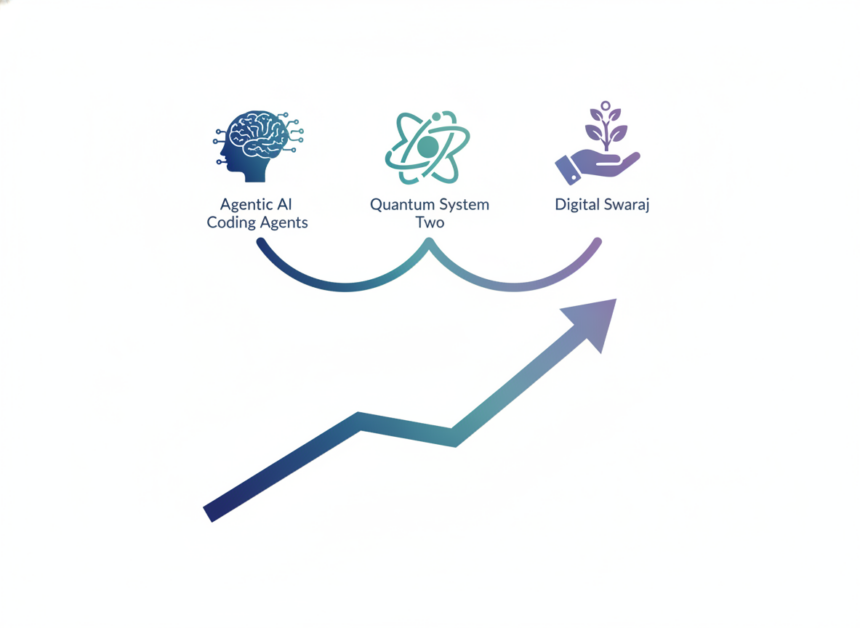
IBM’s strategy across India and South Asia between 2025 and 2026 rests on three pillars: sovereign agentic AI platforms that keep enterprise data inside Indian borders, a physically localised IBM Quantum System Two at Amaravati, and the “Digital Swaraj” framing championed by Sandip Patel, Managing Director of IBM India and South Asia. Together they convert a services relationship into an infrastructure relationship.
The cause is regulatory, not technical. India’s data localisation demands and policy pressure at the Ministry of Electronics and Information Technology level mean cloud-only delivery no longer wins regulated workloads, therefore IBM moved both control planes and physical hardware onshore. A vendor that cannot show where the encryption keys sit loses the bank, the insurer and the state utility before the benchmark conversation starts.
The consequence is competitive rather than technical. Rivals selling remote capability are now arguing on ground IBM chose — jurisdiction rather than benchmark performance. That reframing favours whoever has already committed capital expenditure inside the country, which is why the Amaravati facility matters commercially even before it computes anything.
The three pillars of IBM’s 2025-2026 South Asia strategy
- Sovereign agentic AI — IBM watsonx Orchestrate as the agent control plane, generally available with Yotta’s Shakti Cloud from 29 September 2026
- Sovereign infrastructure — IBM Sovereign Core (March 2026) and IBM Bharat Core, keeping encryption keys and control-plane operations in Indian jurisdiction
- Localised quantum hardware — a 156-qubit Heron-based IBM Quantum System Two at Quantum Valley Tech Park, Amaravati, with TCS and the Government of Andhra Pradesh
- Policy and talent anchoring — the MeitY Startup Hub MoU announced 13 October 2026, plus research expansion with IIT Bombay and IISc Bengaluru from 1 October 2026
What ‘Digital Swaraj’ Means in Practice: Sovereign Core vs Bharat Core
“Digital Swaraj” is IBM India’s term for client control over data, technology assets and AI systems without giving up access to frontier capability. Sandip Patel defined it at IBM Think 2026 in Mumbai on 13 October 2026, positioning it as a response to India’s regulatory and geopolitical environment rather than as a product name.
Patel’s stated position is that the priority is no longer just what AI can do, but how securely, transparently and compliantly it can be deployed. That reframing happened because regulatory exposure now carries a higher expected cost than the performance gap between competing foundation models. A compliance failure in a regulated Indian industry is a licensing problem; a two-point benchmark deficit is a procurement footnote. Consequently the sales conversation moved from capability to custody.
The two similarly named 2026 launches do different jobs, and conflating them leads to bad procurement decisions. Sovereign Core is the jurisdictional control layer: it delivers cloud-like capability inside a client’s own data centre while encryption keys and control-plane operations stay within Indian jurisdiction. Bharat Core is the India-optimised AI stack, offering reusable Indic AI services and models. The effect of shipping both is that one enterprise can satisfy a localisation auditor and an Indic-language product requirement through a single vendor, which raises switching costs considerably. Worth noting the contrast: data sovereignty and data openness are separate policy choices that coexist, as the US federal Data.gov open data portal demonstrates by publishing thousands of government datasets under an openness mandate while residency rules govern other classes entirely.
| Dimension | IBM Sovereign Core | IBM Bharat Core |
|---|---|---|
| Announced | March 2026 | 2026 (date not stated) |
| Primary function | Jurisdictional control layer | India-optimised AI stack |
| Where it runs | Client’s own data centre | Not stated |
| Encryption key custody | Held in Indian jurisdiction | Not stated |
| Indic language services | Not a stated function | Reusable Indic AI services and models |
| Main buyer | Regulated enterprise, government | Product and application teams |
Why localisation pressure, not capability, drove the launch
The March 2026 Sovereign Core launch tracks India’s evolving regulatory landscape and geopolitical data localisation demands rather than any shift in model quality. IBM built a control plane that stays onshore because buyers were being asked by regulators where their keys live, and “a region near you” stopped being an acceptable answer.
One question stays open, and it is the important one: sovereignty of the control plane is not sovereignty of the underlying model weights. An enterprise can hold its keys in Mumbai while depending on foundation models it cannot inspect or retrain. IBM has not publicly resolved that distinction, which means buyers should treat residency and model independence as separate line items.
Agentic AI Coding Agents: The watsonx Orchestrate and Shakti Cloud Stack
On 29 September 2026, IBM and Yotta Data Services made a Sovereign Agentic AI Platform generally available to Indian organisations, pairing IBM watsonx Orchestrate as the agentic control plane with Yotta’s Shakti Cloud for GPU compute, networking and security — an architecture designed so enterprise data never crosses Indian borders.
| Layer | Provider | Function |
|---|---|---|
| Agent orchestration / control plane | IBM | watsonx Orchestrate secures and manages AI agents |
| GPU compute | Yotta | Shakti Cloud compute capacity |
| Networking and security | Yotta | Shakti Cloud networking and security |
| Data residency | IBM and Yotta jointly | Data stays within Indian borders |
| Model and Indic services | IBM | watsonx models; Bharat Core Indic services |
Coding agents deserve separate treatment from the rest of the agentic category, because autonomous agents that read, write and ship code touch source repositories, build pipelines and credentials. That changes the risk surface: a chatbot that hallucinates produces a bad answer, whereas an agent with commit rights produces a merged change. As a result, these deployments create provenance and audit problems that generative chat never did, and the model provenance challenges in multi-institution AI labs that research teams already struggle with get harder when the actor in the pipeline is non-human.
Workloads the platform targets first
- HR process automation
- Document processing and extraction
- Security operations triage
- Software development and coding agents operating against internal repositories
Sunil Gupta, Co-Founder and CEO of Yotta Data Services, has argued that genuine AI sovereignty requires control not only over data but over the underlying infrastructure, compute models and inference operations. That position explains why the partnership exists at all: neither company owned the full stack alone, because IBM brought orchestration and models while Yotta brought the GPU estate and Indian data-centre footprint. The commercial logic is therefore additive rather than defensive.
Two supporting investments feed the same pipeline. IBM opened an Agentic AI Innovation Center in Bengaluru in July 2025 to help enterprises co-innovate multi-agent orchestration strategies, which supplies the deployment-side capacity. On 1 October 2026 IBM announced expanded academic collaborations with IIT Bombay and IISc Bengaluru covering sovereign Indic language model adaptation, multimodal AI and agentic systems — the research-side input. This pairing of enterprise innovation centres with university programmes mirrors how major Western institutions structure responsible AI work, including the University of Michigan College of Engineering’s artificial intelligence research programme, where academic groups handle foundational questions that product teams cannot resource.
Quantum System Two in Amaravati: The Timeline and the Missing Commissioning
The IBM Quantum System Two at Quantum Valley Tech Park in Amaravati — announced on 2 May 2025 with TCS and the Government of Andhra Pradesh — was targeted by IBM CEO Arvind Krishna in July 2026 for commissioning by September 2026. As of 25 October 2026, there is no public confirmation that commissioning has completed. Reporting on 9 October 2026 noted the same absence of an official IBM statement.
The hardware specification was also reported inconsistently during 2026, and that is worth stating rather than smoothing over. Early 2026 reports cited a 133-qubit Heron processor; subsequent official confirmations described a 156-qubit layout optimised for low gate error rates and high fidelity. The discrepancy reflects Heron-family configuration options being firmed up between announcement and installation, which means readers should treat the 156-qubit figure as the current official number and the earlier one as superseded.
| Date | Milestone | Status |
|---|---|---|
| 2 May 2025 | Partnership announced with TCS and Andhra Pradesh | Confirmed |
| 7 February 2026 | Facility construction begins | Confirmed |
| July 2026 | Krishna confirms September commissioning target | Confirmed |
| September 2026 | Targeted commissioning | Target date |
| 9 October 2026 | No official confirmation reported | Reported |
| 25 October 2026 | Commissioning status | Publicly unconfirmed |
On the cause of the slip, restraint is warranted. Quantum installations involve cryogenic plant, electromagnetic shielding and extensive on-site calibration, therefore multi-month variance against a target is routine and a missed date is not evidence of project failure. Large scientific facilities behave this way generally; commissioning schedules at national laboratories such as Oak Ridge National Laboratory, which operates leadership-class computing and experimental facilities, absorb similar variance as a matter of course. The scientific workloads that follow commissioning will also depend on reproducible software plumbing, which is why teams planning hybrid experiments should treat automated data analysis pipelines for physics research as prerequisite work rather than an afterthought.
The consequence that does matter is political. The deployment sits inside India’s ₹6,000-crore National Quantum Mission, and Andhra Pradesh Chief Minister N. Chandrababu Naidu has used it as a state-level industrial argument, so a visible delay carries political cost even where its technical meaning is small. Krishna’s own framing sharpens the point: he has estimated that commercial realisation of quantum computing in pharmaceuticals, AI and materials science is roughly two to three years away. Which means early localised hardware is an investment in domestic intellectual property and trained people, not a near-term revenue line.
What It Means for Pakistan and the Rest of South Asia
In deployment terms, this is an India play first. The Sovereign Core residency guarantees, Shakti Cloud capacity and the Amaravati hardware are all anchored to Indian jurisdiction, so none of the three pillars arrives in Karachi, Dhaka or Colombo as a shipped product.
For enterprises in Pakistan, Bangladesh and Sri Lanka, the practical consequence is that watsonx is reached through regional cloud regions rather than onshore control planes. The sovereignty guarantee that sells the platform to an Indian bank therefore does not transfer, because the legal basis for it — Indian jurisdiction over keys and operations — does not exist elsewhere in the region. Local regulators have also issued no equivalent localisation mandate, which removes the forcing function that pulled IBM’s capital onshore in the first place.
The decisive point is that the template is portable even where the hardware is not. A government that sets enforceable data residency rules and co-funds compute capacity gets onshore infrastructure, because vendor investment follows regulatory certainty rather than market size alone. Andhra Pradesh did not attract a Quantum System Two by being large; it attracted one by pairing a national mission budget with a dedicated tech park and a named corporate partner in TCS.
What is available today across the rest of South Asia: remote quantum access over the cloud, watsonx on shared regional infrastructure, and academic collaboration routes. What is not available: onshore sovereign control planes, local GPU capacity with an Indian-style residency commitment, or physical quantum hardware.
Governance Consequences for Multi-Institution AI Research
Sovereign agentic platforms solve data residency and intensify three governance problems in exchange: model provenance across institutional boundaries, accountability for autonomous agent actions, and reproducibility when the compute environment is jurisdictionally fenced. Research leaders already managing AI governance challenges in multi-institution research labs now have a fourth attribute to track — where the computation legally occurred.
Collaboration breaks at the data boundary first. When one partner’s data cannot leave India and another’s cannot enter a non-approved environment, joint training becomes a legal question before it becomes a technical one, therefore provenance records must capture jurisdiction alongside lineage. This is precisely where the distinction between AI vs traditional data governance stops being academic: traditional lineage answers “what went in”, while agentic systems also require “under whose law did it run, and which autonomous process acted”.
Established frameworks cover more of this than teams assume. The National Institute of Standards and Technology’s AI Risk Management Framework provides a voluntary structure for documenting and managing risks from autonomous systems, with its govern and map functions directly applicable to assigning human accountability for agentic coding workflows. National Science Foundation data management and open science guidance sets expectations for data management plans in funded multi-institution collaborations, which constrains what can lawfully be shared into a jurisdictionally fenced environment. For retention, the National Archives and Records Administration’s recordkeeping and digital preservation standards inform how long agent action logs should survive and what authenticity controls they need.
There is an intellectual property tail as well. Autonomous coding agents generating patentable output raise inventorship and ownership questions that most existing collaboration agreements never contemplated, and current US Patent and Trademark Office guidance on AI and inventorship is the reference point for resolving them before code ships rather than after.
Governance steps to take before deploying agentic coding agents in a multi-institution programme
- Map every data class to its permitted jurisdiction and record the mapping before any agent is granted repository access
- Define agent action logging and retention requirements, aligned to NARA recordkeeping practice, so decisions remain auditable after the project ends
- Document model and dataset provenance including the sovereign environment identifier, not just version hashes
- Assign named human accountability for each autonomous workflow, using the NIST AI RMF govern function as the template
- Settle intellectual property ownership for agent-generated code and inventions in the collaboration agreement, referencing current USPTO guidance
- Run a reproducibility test from a second institution to confirm the jurisdictional fence has not broken verification
Limitations, Unknowns and Alternatives
Any assessment of IBM’s South Asia Play: Agentic AI Coding Agents, Quantum System Two and the Rise of ‘Digital Swaraj’ rests partly on vendor announcements, therefore several claims here remain unverified by independent parties.
Three specific unknowns. First, commissioning of the Amaravati Quantum System Two is unconfirmed as of 25 October 2026, and qubit counts were reported inconsistently — 133, then 156 — during 2026. Second, no published independent audit confirms that the IBM-Yotta sovereign platform keeps all inference and control-plane operations within Indian jurisdiction; that claim originates with the vendors. Third, the $500 billion AI contribution to India’s economy by 2030 is a projection rather than a measurement, and projections of this type carry wide error bands.
One structural limitation deserves emphasis: control-plane sovereignty is not model-weight sovereignty. An enterprise can satisfy residency rules while still depending on foundation models it cannot inspect, retrain or fork.
Alternatives worth weighing against this stack include hyperscaler sovereign cloud regions from AWS, Microsoft and Google; domestic compute providers and India’s own foundation model efforts; and open-weight models self-hosted on local GPU capacity, which reduce vendor dependence at the cost of in-house engineering burden and make a working understanding of open standards in AI a prerequisite rather than a nicety.
Finally, on timing: quantum advantage for pharmaceuticals, AI and materials science is, by Arvind Krishna’s own estimate, roughly two to three years away. No organisation should plan production quantum workloads on this hardware in 2026.
Conclusion
IBM’s South Asia Play: Agentic AI Coding Agents, Quantum System Two and the Rise of ‘Digital Swaraj’ resolves into a clear verdict rather than a uniform one. The agentic AI pillar is shipping and commercially real, generally available since 29 September 2026 with named workloads and a named compute partner. The sovereignty pillar is a regulatory response that is already reshaping how regulated Indian buyers score vendors, because custody now outranks capability in those evaluations. The quantum pillar is a long-dated bet on domestic intellectual property whose first public milestone has already slipped past its September 2026 target.
The transferable lesson is causal: IBM invested onshore because India legislated certainty, therefore regulatory clarity precedes infrastructure rather than following it. South Asian governments hoping to attract comparable capital should read the sequence in that order.
Two checkpoints will settle the open questions — official confirmation of Amaravati commissioning, and the first independent audit of the sovereign platform’s residency claims. Until then, teams building on this stack should start with the governance layer: our guide on how to build a robust AI data governance framework covers the implementation detail.
Frequently Asked Questions
What is IBM’s South Asia play and why does it matter now?
IBM’s South Asia Play: Agentic AI Coding Agents, Quantum System Two and the Rise of ‘Digital Swaraj’ describes IBM’s 2025-2026 shift from services vendor to sovereign infrastructure partner in India. It matters now because India’s localisation rules and the projected $500 billion AI contribution to the economy by 2030 made jurisdictional control the deciding procurement factor, therefore onshore capital expenditure became a competitive requirement rather than an option.
What does ‘Digital Swaraj’ mean?
It is IBM India MD Sandip Patel’s term for enterprise and government control over data, technology assets and AI systems without sacrificing innovation, set out at IBM Think 2026 in Mumbai on 13 October 2026. Readers should note it is a positioning term, not a standard or certification, which means no independent body audits compliance against it.
Is IBM’s Quantum System Two in Amaravati operational?
Not publicly confirmed as of 25 October 2026. Construction began 7 February 2026, Arvind Krishna targeted September 2026 commissioning when speaking in July 2026, and reporting on 9 October 2026 noted no official confirmation had appeared. Cryogenic installation and calibration timelines commonly slip at this scale, therefore the delay is not evidence of cancellation.
How many qubits does the India Quantum System Two have?
A 156-qubit Heron processor, per later official confirmation, after early 2026 reports cited 133 qubits. The layout is described as optimised for low gate error rates and high fidelity, which means usable circuit depth matters more for practical work than the headline qubit count does.
What is IBM’s sovereign agentic AI platform in India?
A platform made generally available on 29 September 2026 by IBM and Yotta Data Services, pairing IBM watsonx Orchestrate as the agentic control plane with Yotta’s Shakti Cloud for GPU compute, networking and security. Target workloads are HR automation, document processing, security operations triage and coding agents, with data kept inside Indian borders.
Are IBM Sovereign Core and Bharat Core the same thing?
No. Sovereign Core, announced March 2026, delivers cloud-like capability inside a client’s own data centre with encryption keys and control-plane operations held in Indian jurisdiction. Bharat Core is an India-optimised AI stack providing reusable Indic AI services and models. They are complementary layers, which is why many deployments reference both.
Can companies in Pakistan use these IBM sovereign offerings?
Not with the same guarantees. The residency commitments, Shakti Cloud capacity and Amaravati hardware are tied to Indian jurisdiction, which means organisations elsewhere in South Asia access watsonx through regional cloud regions and remote quantum access instead. Onshore equivalents require local residency mandates and public co-investment first, because vendor capital follows regulatory certainty.
What are the critical AI governance challenges in multi-institution research?
Provenance across institutional boundaries, inconsistent data-sharing permissions, accountability for autonomous agents, reproducibility, and intellectual property ownership. Sovereign deployments add jurisdiction as a provenance attribute, therefore documentation must record where a model was trained as well as what it was trained on — a point covered in depth in our analysis of AI governance challenges in multi-institution research labs.
How can model provenance be tracked in sovereign agentic AI environments?
By recording dataset lineage, model version hashes, the sovereign environment identifier and the agent action log in a single immutable record. NIST AI RMF documentation practice and NARA retention guidance supply the structure, and our breakdown of model provenance challenges in multi-institution AI labs sets out how the records interlock.
How does IBM’s India strategy connect to the National Quantum Mission?
The Amaravati deployment sits inside India’s ₹6,000-crore National Quantum Mission, which Andhra Pradesh Chief Minister N. Chandrababu Naidu has cited as the policy anchor for the project. The effect is that state and national industrial policy, rather than enterprise demand, is funding the first localised quantum hardware in the country.
References
- National Institute of Standards and Technology — AI Risk Management Framework: https://www.nist.gov/
- National Science Foundation — data management and open science guidance: https://www.nsf.gov/
- U.S. Patent and Trademark Office — AI and inventorship guidance: https://www.uspto.gov/
- National Archives and Records Administration — recordkeeping and digital preservation standards: https://www.archives.gov/
- Oak Ridge National Laboratory: https://www.ornl.gov/
- University of Michigan College of Engineering — Artificial Intelligence research: https://www.engin.umich.edu/research/artificial-intelligence/
- Data.gov — US government open data: https://www.data.gov/