
Foundational Understanding: What is OpenAI Agentkit?
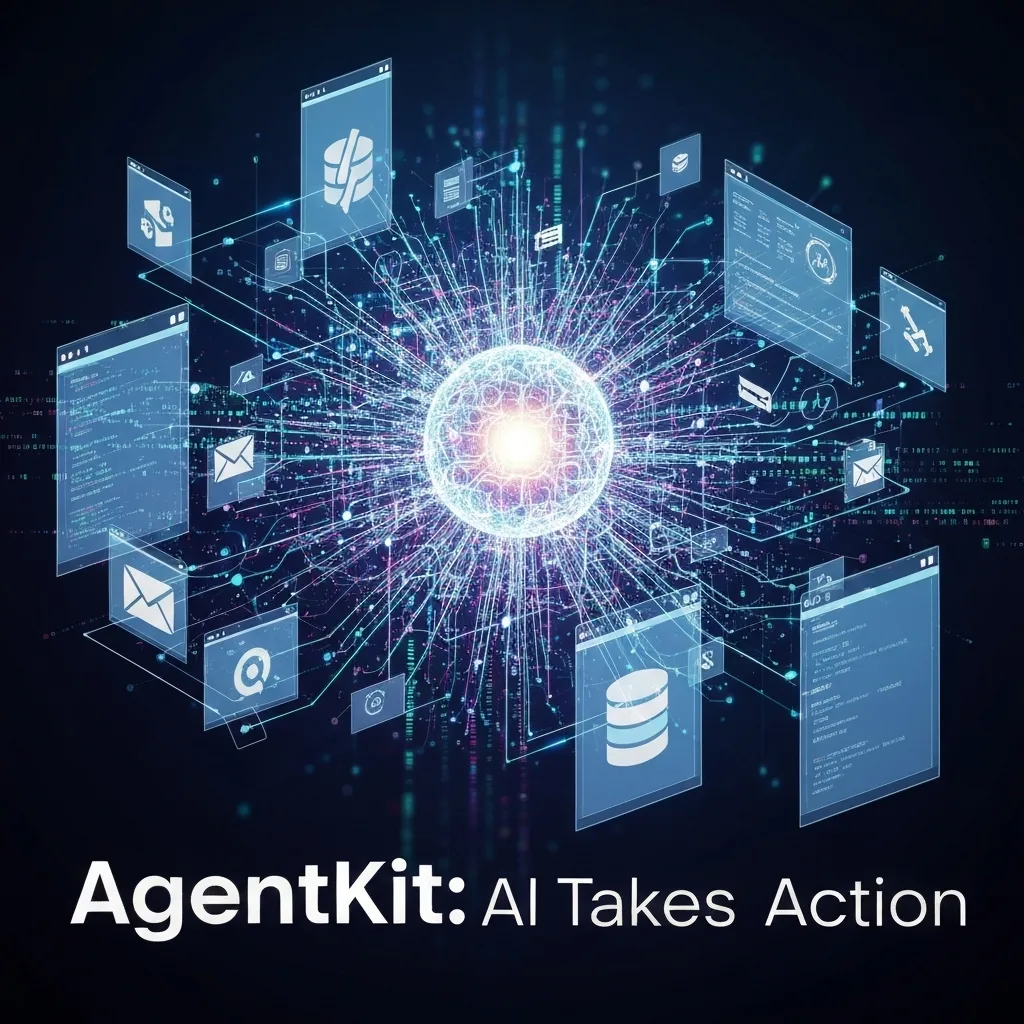
According to OpenAI, AgentKit is a complete platform for agent development, providing the tools to build agentic workflows, deploy UI, and optimize performance. Officially released on October 6, 2025, this framework is a specialized toolkit for developers. Instead of just responding to a single prompt, agents built with Agentkit can perform complex, multi-step tasks by reasoning, planning, and using other tools to achieve a specific goal. This framework provides the essential building blocks—like memory, planning capabilities, and tool integration—that allow an AI to function less like a chatbot and more like an independent assistant. OpenAI describes AgentKit as a platform that provides the tools to build agentic workflows, enabling LLMs to interact with their environment and execute tasks autonomously. In short, Agentkit is the bridge between a powerful language model and the ability to take meaningful action in the digital world.
Key Features & Functionality of Agentkit
To truly grasp the potential of Agentkit, it’s essential to understand its underlying components and mechanics. These features are what elevate a standard LLM into a functional, task-oriented agent.
Unpacking the Core Features
OpenAI’s AgentKit features include a visual workflow builder, embeddable chat UI, and tools for deployment and performance optimization, supporting robust tool integration, planning, memory, and autonomous operation. The framework is built around a few key pillars:
| Feature | Description |
|---|---|
| Tool Integration | Allows the AI agent to access and use external software, APIs, or data sources to perform actions in the digital world. |
| Planning & Reasoning | Enables the agent to break down a complex goal into a sequence of smaller, manageable steps and adapt its plan if it encounters obstacles. |
| Memory & State Management | Provides both short-term (task-specific) and long-term memory, allowing for context-aware operations across multiple steps. |
| Autonomous Operation | Allows agents to run independently to achieve a set goal, making decisions and executing steps without constant human intervention. |
The Inner Workings: How OpenAI Agentkit Works
Understanding how openai agentkit works involves looking at the typical lifecycle of an agent’s task. It generally follows this process:
- Goal Definition: A developer or user provides the agent with a high-level objective (e.g., “Summarize the top 5 AI news articles from this week and email the summary to the team”).
- Planning Phase: The agent, using its underlying LLM, breaks the goal down into a logical sequence of actions. For the example above, this might be: “1. Search the web for ‘AI news this week’. 2. Identify 5 credible articles. 3. Read and summarize each article. 4. Compile the summaries. 5. Draft an email. 6. Send the email to the specified recipients.”
- Tool Selection & Execution: For each step, the agent selects the appropriate tool it has been given. It might use a web search tool for step 1, a text-summarization tool for step 3, and an email API for step 6.
- Observation & Adaptation: After each action, the agent observes the result. If a step fails or produces an unexpected outcome, it can use its reasoning ability to adapt its plan and try a different approach.
- Completion: The agent continues this loop of planning, executing, and observing until the final goal is achieved.
Real-World Use Cases & Applications for Developers
The true excitement around Agentkit lies in its practical applications. By enabling LLMs to take action, it opens up a vast range of possibilities for automation and intelligent software.
Practical Applications in Action
There are numerous openai agentkit use cases across various industries. Some of the most compelling examples include:
| Use Case | Example Application |
|---|---|
| Automated Software Engineering | An agent scans a codebase for bugs, writes corresponding unit tests, and documents its findings in a markdown file automatically. |
| Data Analysis & Reporting | An agent connects to a sales database, analyzes performance trends, generates a visual report, and emails it to stakeholders. |
| Personal Digital Assistants | An assistant that books flights, makes dinner reservations, and proactively reschedules conflicting calendar appointments based on user priorities. |
| Complex Customer Support | An agent handles a full customer return workflow, from locating the order and processing the refund to generating a shipping label. |
Getting Started: Agentkit for Developers
For developers looking to dive in, agentkit for developers offers a more structured and efficient way to build agentic workflows compared to starting from scratch. Implementing openai agentkit typically begins with setting up your development environment and installing the necessary libraries. From there, the process involves defining the agent’s core prompt or “constitution,” providing it with a set of tools (APIs), and giving it a goal. While this article provides a high-level overview, a hands-on approach is the best way to learn. For a more detailed walkthrough, we encourage you to read our complete guide to OpenAI Agentkit. This resource covers the specific code and steps needed to build your first agent.
Frequently Asked Questions
What is the main purpose of OpenAI Agentkit?
The main purpose of OpenAI Agentkit is to provide developers with a framework and a set of tools to build autonomous AI agents. It simplifies the process of giving large language models (LLMs) the ability to plan, use external tools (like APIs), and execute complex, multi-step tasks to achieve a specific goal.
How do developers use Agentkit?
For developers, Agentkit is used as a foundational library to create applications where AI can take action. Instead of building complex planning, memory, and tool-integration systems from scratch, developers can use Agentkit to accelerate the development of sophisticated agents for tasks like automated data analysis, software debugging, or creating powerful personal assistants.
Is OpenAI Agentkit difficult for new developers to learn?
While some programming knowledge is required, Agentkit is designed to lower the barrier to entry for building AI agents. Its structure provides a clear path for developers, even those relatively new to AI, to start implementing agentic workflows. However, building highly complex and reliable agents still requires a solid understanding of both software development and AI principles.