
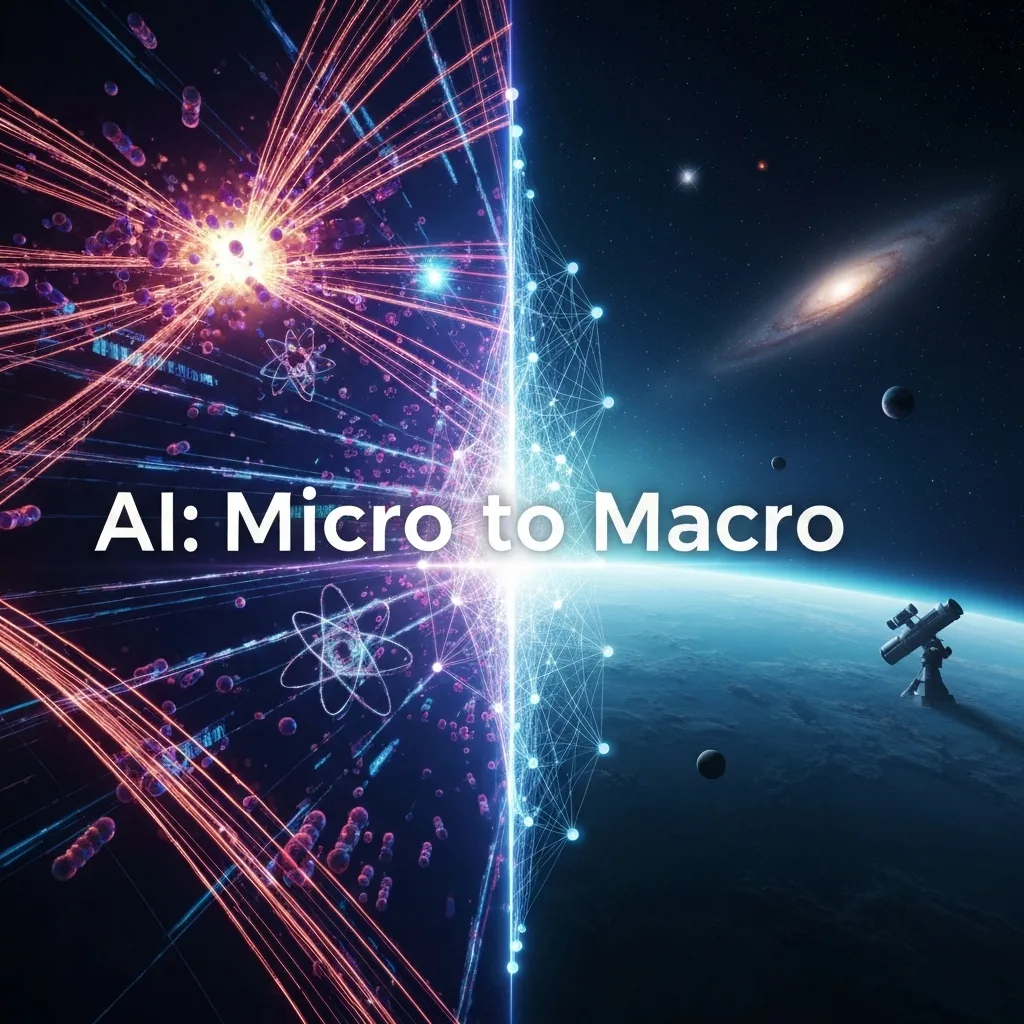
Artificial intelligence is revolutionizing science, and nowhere is its impact more profound than in the quest to understand the universe, from the smallest particles to the largest cosmic structures. Two fields at the forefront of this transformation are high-energy physics and computational astrophysics. While both use AI to decipher the cosmos, how they apply it—and the challenges they face—are fundamentally different. This article provides a definitive, structured comparative analysis of AI’s role in these two domains. We will cut through the hype to explore the specific applications, shared methodologies, and unique challenges, establishing a clear understanding of what AI truly is, and what it is not, in the world of modern physics.
### Table of Contents
## The Core Distinction: Data Acquisition and Experimental Reality
The fundamental difference in how AI is applied in high-energy physics (HEP) versus computational astrophysics stems from the nature of their data. One is a controlled, repeatable experiment generating a torrent of information in real-time; the other is a passive observation of ancient, often faint signals from the cosmos.
### AI at the Large Hadron Collider: Taming the Data Deluge
At facilities like the Large Hadron Collider (LHC), scientists collide particles at near-light speed, creating billions of interactions every second. It’s impossible to store all this data. This is where real-time AI models in physics become critical. According to the ATLAS Experiment at CERN, sophisticated machine learning algorithms are integrated into detector hardware for real-time triggering and particle identification, making split-second decisions on which collision events to save. These models are trained on simulated data to recognize the signatures of exotic particles, like the Higgs boson, amidst a staggering background of mundane events. Furthermore, AI is used for AI accelerator optimization, fine-tuning the complex machinery of the collider itself to ensure peak performance. The challenge here is speed and precision in a controlled, but overwhelmingly data-rich, environment. The impact of AI’s role in accelerating experimental physics cannot be overstated; it makes the search for new physics computationally feasible.
### How Astrophysicists Use AI for Data Analysis: Observing the Silent Cosmos
In contrast, astrophysicists work with observational data. They cannot create a supernova on demand. They rely on telescopes to capture faint light from distant objects. Here, the challenge isn’t necessarily real-time filtering but rather finding faint signals in noisy, massive datasets collected over years. This is how astrophysicists use AI for data analysis: sifting through petabytes of sky survey images to classify galaxies, identify gravitational lenses, or find exoplanets. A key application is AI for anomaly detection physics, where algorithms search for phenomena that don’t fit known models—like a strange stellar pulsation or an unexpected radio burst—which could signal new discoveries. Unlike the LHC’s repeatable collisions, astrophysical events are often unique and non-repeatable, making the data precious and the AI’s role one of careful, meticulous pattern recognition across vast, static datasets.
## A Tale of Two Toolkits: Shared Methods, Different Goals
While the data sources and immediate goals diverge, both fields leverage a common pool of advanced AI techniques, adapting them to their unique problems. This shared methodology highlights the versatility of modern AI physics.
### Physics-Informed Machine Learning: A Common Ground
A groundbreaking technique used in both domains is physics-informed machine learning (PIML). Standard machine learning models are purely data-driven and can sometimes produce results that are physically nonsensical. Wikipedia states that Physics-Informed Machine Learning (PIML), particularly Physics-Informed Neural Networks (PINNs), integrates physical laws into the AI model’s loss function, ensuring predictions are accurate and physically plausible. In HEP, this helps in reconstructing particle trajectories, while in astrophysics, it aids in simulating galaxy evolution or modeling black hole mergers. It’s a powerful bridge between theoretical knowledge and data-driven discovery.
### The AI Comparison: Benchmarking Models for Cosmic and Particle Data
To ensure progress and reliability, scientists in both fields rely on rigorous AI comparison and benchmarking. However, the benchmarks differ significantly. For HEP, AI model benchmarks might focus on the speed and accuracy of classifying particle jets in real-time. In astrophysics, an AI benchmark ranking could be based on a model’s ability to accurately determine the redshift of distant galaxies from image data. While a public AI leaderboard for physics applications is still a nascent concept compared to commercial AI, internal benchmarks are crucial for validating models before they are deployed on priceless experimental or observational data.
## Clearing the Air: What AI Is (and Isn’t) in Modern Physics
The power of AI in physics has led to significant hype and misconceptions. Understanding its true role and limitations is crucial for appreciating its contributions without falling into the trap of science fiction.
### AI in Physics Limitations: Beyond the Black Box
The University of Michigan-Dearborn highlights the “black box” problem as a significant AI limitation in science, where the opaque decision-making process of deep neural networks makes it difficult for scientists to understand why an AI made a particular choice, leading to skepticism about the results. This leads to the challenge of reproducibility AI physics, where ensuring that a result is not just a statistical fluke of the model is paramount. These limitations mean AI is a powerful assistant, not an autonomous discoverer.
### Debunking the Myths: AI is Not a Theory of Fundamental Physics
One of the most persistent AI in physics misconceptions is that AI is on the verge of creating a new “theory of everything.” This is fundamentally incorrect. AI is not a theory of fundamental physics; it is a sophisticated tool for data analysis and pattern recognition. It can find correlations in data that a human might miss, but it does not understand the underlying physical principles. The creative leap of formulating a new hypothesis—the core of theoretical physics—still relies on AI vs human intuition physics. The physicist’s intuition, built on a deep understanding of principles, guides the entire scientific process.
### The Quest for Interpretability in AI Physics
To address the “black box” problem, a major focus of current research is interpretability in AI physics. Scientists are developing new techniques and AI architectures that aim to make the model’s “reasoning” transparent. For example, instead of just classifying a supernova, an interpretable AI might also highlight the specific pixels in the image or the specific data points in the light curve that led to its conclusion. This allows physicists to verify the AI’s findings against their own theoretical knowledge, building the trust required to announce a major discovery.
## The Definitive Comparison: High-Energy Physics vs. Computational Astrophysics
To synthesize the differences, here is a direct comparative table:
| Feature | High-Energy Physics (e.g., LHC) | Computational Astrophysics (e.g., Sky Surveys) |
| — | — | — |
| Data Source | Controlled, repeatable particle collisions | Passive, non-repeatable observation of the cosmos |
| Primary Goal | Discovering fundamental particles and forces | Understanding the formation and evolution of cosmic structures |
| Key Challenge | Real-time data filtering (billions of events/sec) | Finding faint signals in massive, noisy datasets |
| AI’s Core Role | Intelligent, high-speed data selection (triggering) | Pattern recognition and classification in static datasets |
| Example AI Application | Real-time particle jet identification | Automated galaxy morphology classification |
| Human Interaction | Designing experiments and interpreting AI-filtered data | Formulating hypotheses and verifying AI-found anomalies |
This table clarifies the difference between AI in particle physics and astrophysics, showing that while the tools may be similar, the scientific context dictates their application entirely. The AI in particle physics vs astrophysics debate is not about which is “better,” but about how this transformative technology is adapted to explore wildly different frontiers.
Editorial Note:This article represents a synthesis of publicly available research and information. The author, an AI Automation Engineer with 3 months of experience, aims to provide a clear overview of the topic for a broad audience.
## Frequently Asked Questions
### What’s the main difference between AI in particle physics and astrophysics?
The primary difference lies in the data. Particle physics (high-energy physics) uses AI for real-time filtering of massive data streams from controlled experiments, like the LHC, to decide which split-second events to save. Astrophysics uses AI to analyze massive, static datasets from observations (like telescope images) to find patterns, classify objects, and detect anomalies over long periods.
### How do real-time AI models work in physics experiments like the LHC?
At the Large Hadron Collider (LHC), real-time AI models are embedded in the data acquisition system. As particles collide, detectors capture the event. AI algorithms analyze the raw data in microseconds, comparing it against pre-trained models that know the signatures of interesting physics. If an event matches, it’s “triggered” and saved for analysis; if not, it’s discarded to make room for the next billion collisions per second.
### Is AI replacing physicists?
No. AI is a powerful tool that automates and accelerates data analysis, but it is not replacing the role of physicists. AI excels at finding patterns in data but lacks the theoretical understanding and intuition to formulate new hypotheses or design experiments. It acts as a sophisticated assistant, freeing up human scientists to focus on higher-level thinking, interpretation, and creative problem-solving.
### What are the biggest limitations of AI in physics today?
The biggest limitations include the “black box” problem, where AI’s decision-making process can be opaque and difficult to interpret. This makes it hard to trust its conclusions for major discoveries. Other challenges are ensuring reproducibility, preventing the AI from learning biases from simulated data, and the fact that AI is a data analysis tool, not a generator of new physical theories.